For years, homeowners in Palm Bay living within tile-dominant communities have hit the exact same roadblock. They apply for a highly durable metal roof upgrade, only to have their Homeowners’ Association (HOA) reject the application based purely on aesthetic guidelines.
If this sounds familiar, there is good news. As of 2024, a flat-out denial simply because the roof is metal no longer holds up under Florida law.
Here is exactly what you need to know about navigating your HOA and getting your metal roof approved in Palm Bay.
Can a Florida HOA Outright Deny a Metal Roof?
The short answer is no. An HOA can no longer reject a roofing application solely because the material is metal. Recent changes to Florida law heavily restrict how far a board’s aesthetic preferences can dictate your home’s hurricane defense.
Under House Bill 293 (the Hurricane Protections for Homeowners’ Associations law, effective May 2024), a new subsection was added to Florida Statute 720.3035. This law categorizes roof systems that meet Florida Building Code standards as officially recognized “hurricane protection” (alongside impact windows and storm shutters).
Because of this, every HOA in Florida is legally required to have written hurricane protection specifications on file. If your roofing product complies with these building codes, the board cannot deny your application just because you chose metal instead of traditional tile. If they reject a compliant roof without pointing to their specific adopted guidelines, they are acting outside of state law.
What Your Palm Bay HOA Can Still Control
While House Bill 293 limits the architectural review committee’s power, it does not erase it completely. Your board can still enforce a unified building scheme.
This means the HOA can legally insist that your new metal roof visually blends in with the neighborhood’s established style, profile, or color palette. Most Palm Bay HOAs restrict roofing colors to neutral grays, earth tones, or classic terracotta, and many will require physical material samples before giving the green light.
The law guarantees you a fair shot at installing metal, but the specific style of metal you choose will ultimately determine if the board says yes.
Metal Roofing Styles Engineered to Match Tile
To avoid instant pushback, skip the generic, industrial metal panels. Instead, choose a profile specifically designed to satisfy strict HOA aesthetic rules:
-
Stone-Coated Steel Panels: These panels flawlessly replicate the distinct curves, shapes, and deep shadow lines of concrete or clay barrel tiles. From the street level, it is incredibly difficult for a board to tell the difference.
-
Textured Metal Shakes & Shingles: If your community leans away from heavy barrel tile and prefers a textured look, metal shake profiles recreate the multi-dimensional appearance of premium architectural shingles.
-
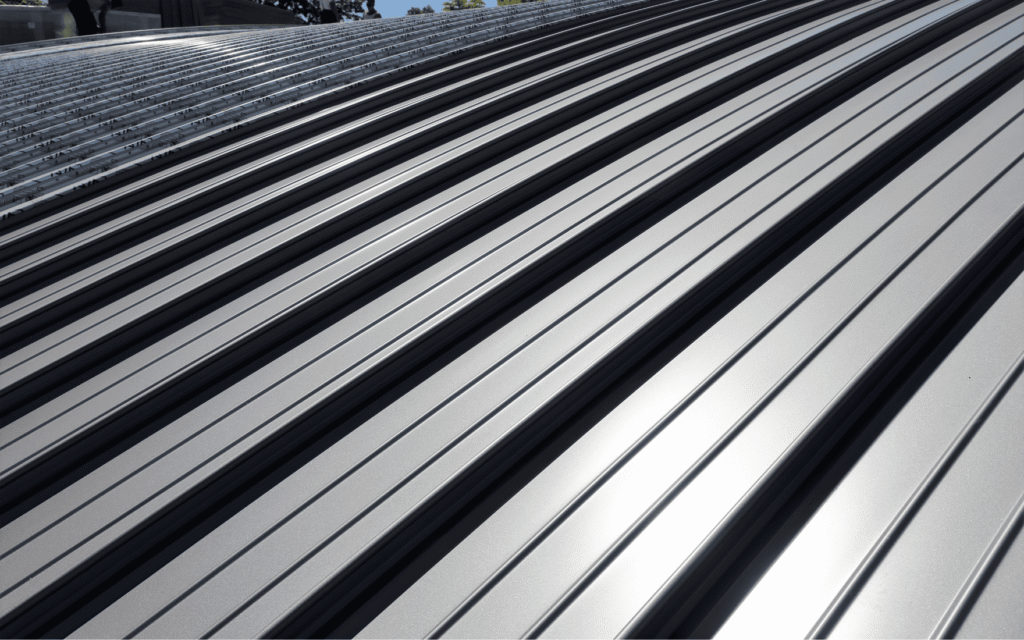
Color-Matched Standing Seam: For HOAs that care more about the overall color palette than the physical shape of the tile, a standing seam metal roof finished in muted earth tones, clay, or terracotta is often an easy approval.
By presenting one of these specialized options, you shift the board’s question from “Should we allow metal?” to “Does this specific product fit our neighborhood?”—a much easier hurdle to clear.
A Step-by-Step Guide to Getting HOA Approval
Navigating an HOA application does not have to be a headache. Follow these steps to secure approval for your Palm Bay home:
-
Request the Guidelines: Pull your HOA’s current architectural rules and their legally required “hurricane protection specifications.” If they haven’t written these specifications yet, politely remind them that Florida law now mandates it.
-
Select a Tile-Matching Profile: Before submitting anything, choose a metal style and color that perfectly aligns with your community’s visual standards.
-
Submit a Complete Packet: Turn in a comprehensive application. Include exact product specifications, manufacturer warranties, wind uplift ratings, and physical samples if required.
-
Document Everything in Writing: Keep a strict paper trail. Submit your application via email, log all dates, and follow up in writing if the board fails to respond within a reasonable timeframe.
-
Escalate if Necessary: If the board stalls indefinitely or ignores a fully compliant application, hold your ground. They may be acting in violation of Florida statutes.
Ready to Make the Switch in Palm Bay?
At Yeti Roofing, our local team has successfully guided homeowners throughout Brevard County through this exact process. We know exactly what Palm Bay HOA boards are looking for, from tile-matching material selection to full, code-compliant installations.
Because we work directly with top-tier material suppliers, we can put HOA-ready documentation and physical profile samples right in front of your board without any unnecessary delays. Don’t let outdated HOA rules compromise your home’s protection. Reach out to our crew today for a transparent quote and get your roofing done right!
Frequently Asked Questions (FAQ)
Can my Florida HOA still deny a metal roof application? Only if the specific application fails to meet the association’s adopted hurricane protection specifications or local building codes. An architectural board can no longer deny it simply because the base material is metal.
Does my HOA control the color or style of my metal roof? Yes. Under Florida law, associations can still require a new metal roof to conform to the neighborhood’s unified building scheme. This includes dictating the acceptable colors, panel profiles, and general architectural style.
What if my HOA hasn’t adopted written hurricane protection specifications? House Bill 293 makes it a legal requirement for every Florida HOA to adopt them. If your association hasn’t updated its rules, raise this issue directly with the board before or during your application process.
Is stone-coated steel a good option for a tile-style community? Yes, it is often the most successful choice. It physically replicates the classic shape and aesthetic shadow lines of a barrel tile roof while delivering the superior durability and wind resistance of metal, making it an incredibly easy sell to aesthetics-focused boards.